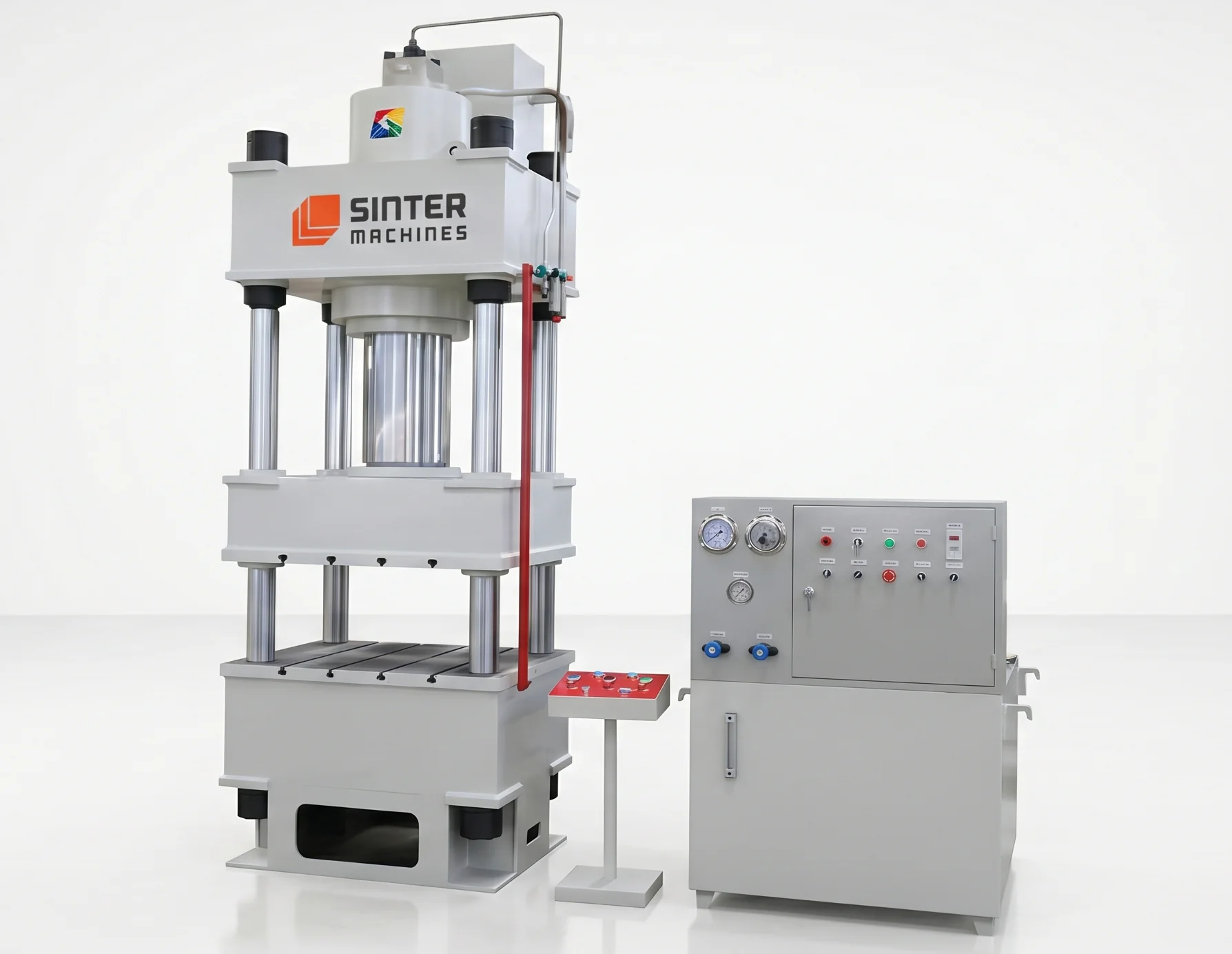
01 — Press System
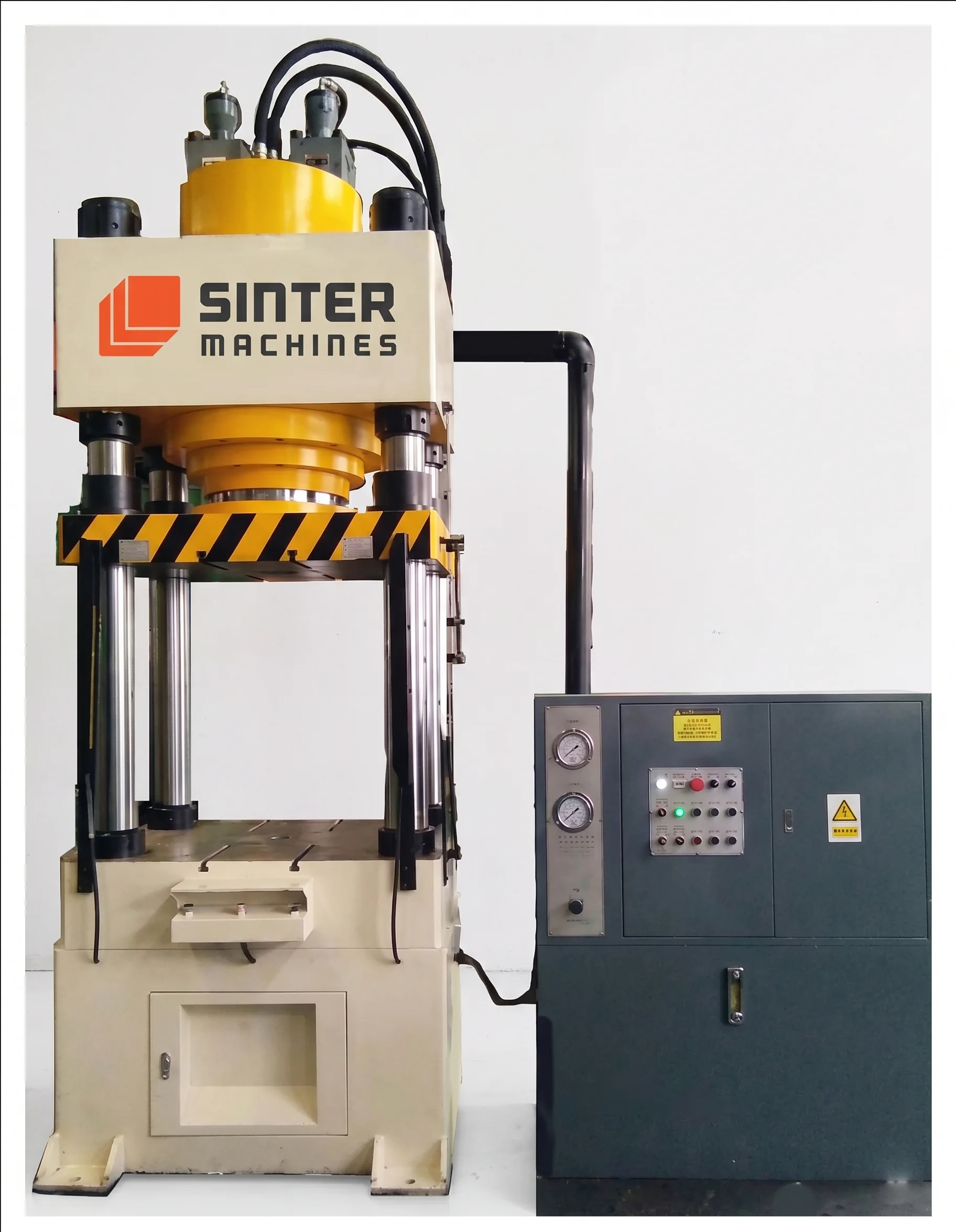
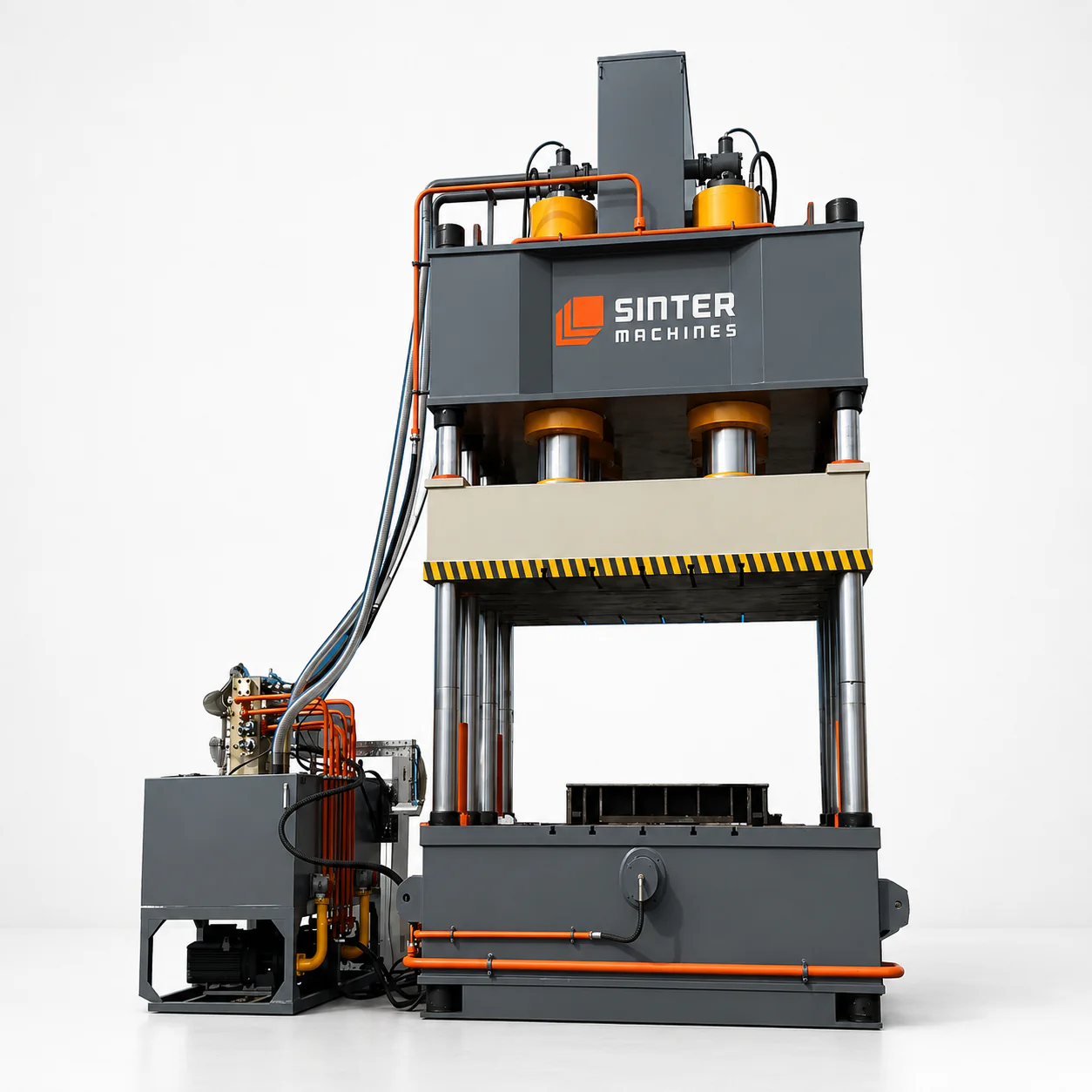
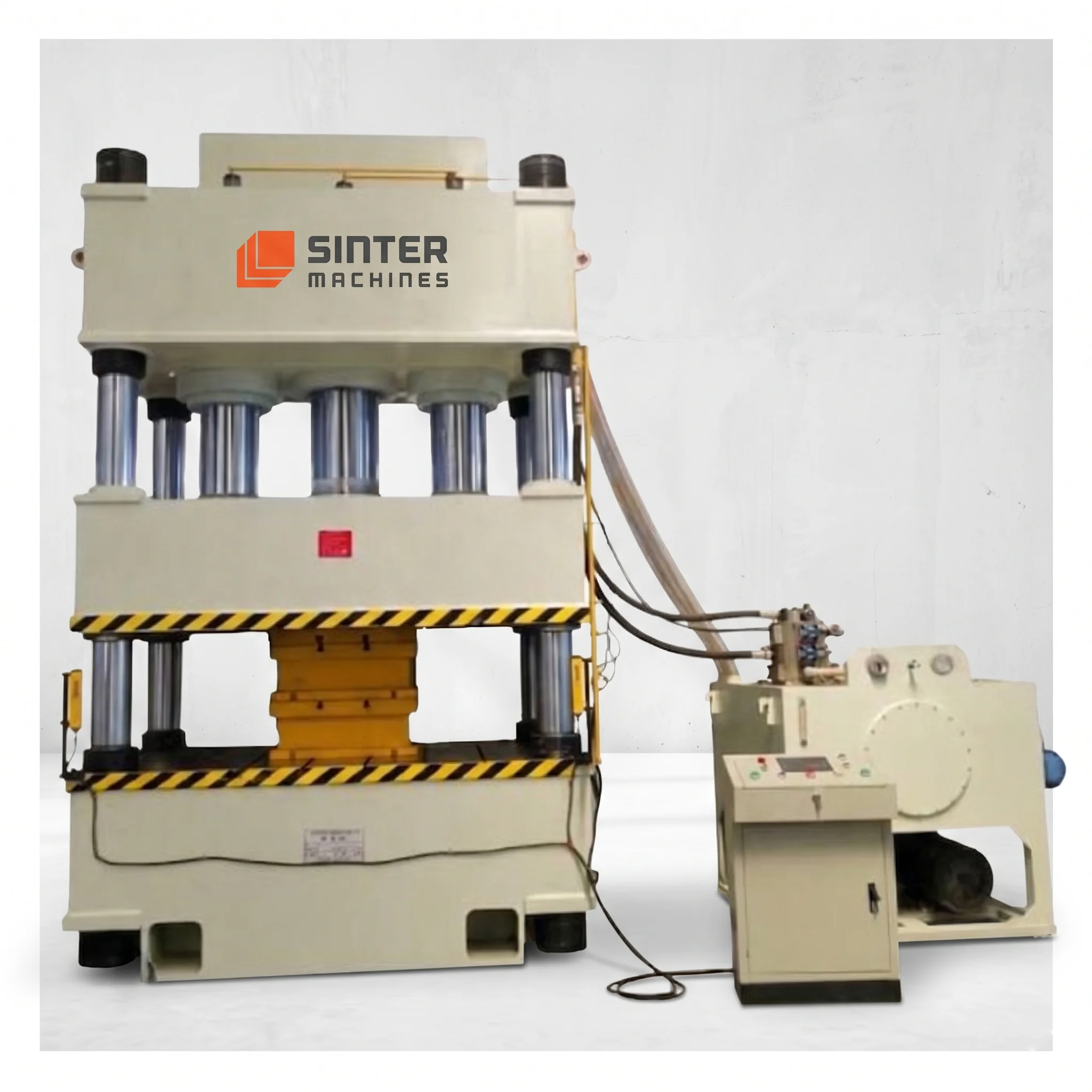
1000 Ton Four Pillar Hydraulic Press Machine
The 1000 Ton Four Pillar Hydraulic Press from Sinter Hydraulics India is a benchmark solution for the cookware impact bonding (cladding) process, delivering extremely high and controlled impact force for creating strong, permanent metallurgical bonds between multiple metal layers. It ensures uniform heat-transfer characteristics, superior cookware performance, and consistent quality across high-volume production environments.
Use Case
The 1000 Ton Hydraulic Press is widely used for impact bonding stainless steel cookware with aluminum and induction-grade stainless steel discs to create multi-layer cookware bases. This process produces high-performance cookware with superior heat distribution, energy efficiency, and long-lasting bonding strength.
- Core Applications: Impact bonding and cladding of cookware bases for induction-compatible pots, pans, pressure cookers, saucepans, and commercial cookware products.
- Material: Stainless steel, aluminum, induction stainless steel discs, ferritic stainless steel, and multi-layer metal combinations used in premium cookware manufacturing.
- Typical Products Formed: Induction cookware, frying pans, cooking pots, saucepans, pressure cooker bodies, stock pots, and multi-layer kitchen utensils.
- Key Functions: Impact bonding, cladding, metal joining, base attachment, high-pressure pressing, and formation of uniform metallurgical bonds between dissimilar metals.
- Why 1000 Ton Hydraulic Press?: The 1000-ton capacity delivers the high and uniformly distributed force required for strong, defect-free bonding of cookware base materials. It ensures excellent bond integrity, improved thermal performance, high productivity, and extended tooling life for large-scale cookware production.
02 — Technical Specifications
SM 1000 HP – HYDRAULIC PRESS MACHINE COMPLETE TECHNICAL DATA
SM 1000 HP – 1000 Ton Hydraulic Press Machine is a high-performance industrial press engineered for the cookware impact bonding (cladding) process, delivering extremely high and precisely controlled force to create strong metallurgical bonds between stainless steel cookware bodies and aluminum or induction-grade steel base discs. Its robust four-pillar construction, advanced hydraulic controls, and high production capability ensure consistent bonding quality, excellent thermal conductivity, superior induction performance, low rejection rates, and reliable long-term operation for large-scale cookware manufacturing.
Press Machine Parameters
- Nominal Force: 10,000 kN (1000 Ton)
- Structure: Four-pillar (four-column), prestressed frame
- Frame Type: Welded steel + tie-rod pre-tensioning
- Guiding Accuracy: ≤ 0.10 mm parallelism
Working Parameters
- Daylight (Opening height): 1800–2200 mm
- Slide Stroke: 1000–1400 mm
- Bed Size:
- Length: 2500–4000 mm
- Width: 1500–2500 mm
- Cushion Force (optional): 200–400 Ton
Speed Parameters
- Fast Down Speed: 200–350 mm/s
- Press Speed: 5–20 mm/s (precision control)
- Return Speed: 150–250 mm/s
Hydraulic System
- Pressure Range: 25–31.5 MPa
- Control: Proportional servo valve / servo pump system
- Oil Cooling: Integrated heat exchanger
- Filtration: NAS 7–8 cleanliness level
Control System
- PLC: Siemens / Allen-Bradley
- HMI: Touchscreen panel (multi-language)
- Control Modes:
- Pressure control
- Stroke control
- Position + pressure switching
- Multi-stage forming
Safety Standards
- Complies with:
- ISO 16092 (hydraulic press safety)
- CE certification
- Light curtain + two-hand operation
- Overload protection
- Emergency stop system
Automation Compatibility
- Robot integration (6-axis handling arm)
- Sheet feeder / destacker
- Vision alignment system (optional)
- Quick die change (QDC) system
SM 1000 HP — Model Specifications
- Nominal Force: 10000 KN
- Maximum Hydraulic Pressure: 25 MPa
- Max Opening Height of the Slider: 1500 mm
- Max Stroke of the Slider: 900 mm
- Effective Bed Size: 1600 × 1600 mm
- Slider Down Speed: 180 mm/s
- Slider Pressing Speed: 10–18 mm/s
- Slider Return Speed: 220 mm/s
- Ejector Cylinder Nominal Force: 600 KN
- Stroke of the Ejection Cylinder: 300 mm
03 — Die / Mold System
Precision Cookware Impact Bonding (Cladding) Process Die Mold Engineering
The die mold system is engineered for precise alignment and high-pressure impact bonding of cookware components, ensuring strong and uniform metallurgical bonding. Its robust design delivers consistent bonding quality, extended tooling life, and reliable high-volume production performance.
Technical Specifications (Tooling)
Die Type: Precision impact bonding and cladding die set.
Die Materials: Hardened alloy tool steel (H13/D2 grade).
Tool Configuration & Construction: Upper punch, lower die, alignment guides, backing plates, and reinforced die holder assembly.
Key Tooling Features: Uniform force distribution, precision positioning, wear resistance, and replaceable inserts.
Alignment Accuracy: Up to ±0.03 mm for accurate component positioning.
Materials Formed: Stainless steel, aluminum, ferritic stainless steel, and induction base discs.
Surface Finish: Precision-ground and polished surfaces with Ra 0.2–0.8 µm finish.
Tool Life: Typically, 1,000,000+ bonding cycles with proper maintenance.
Precision Cookware Impact Bonding (Cladding) Process Die Mold
04 — Product Application
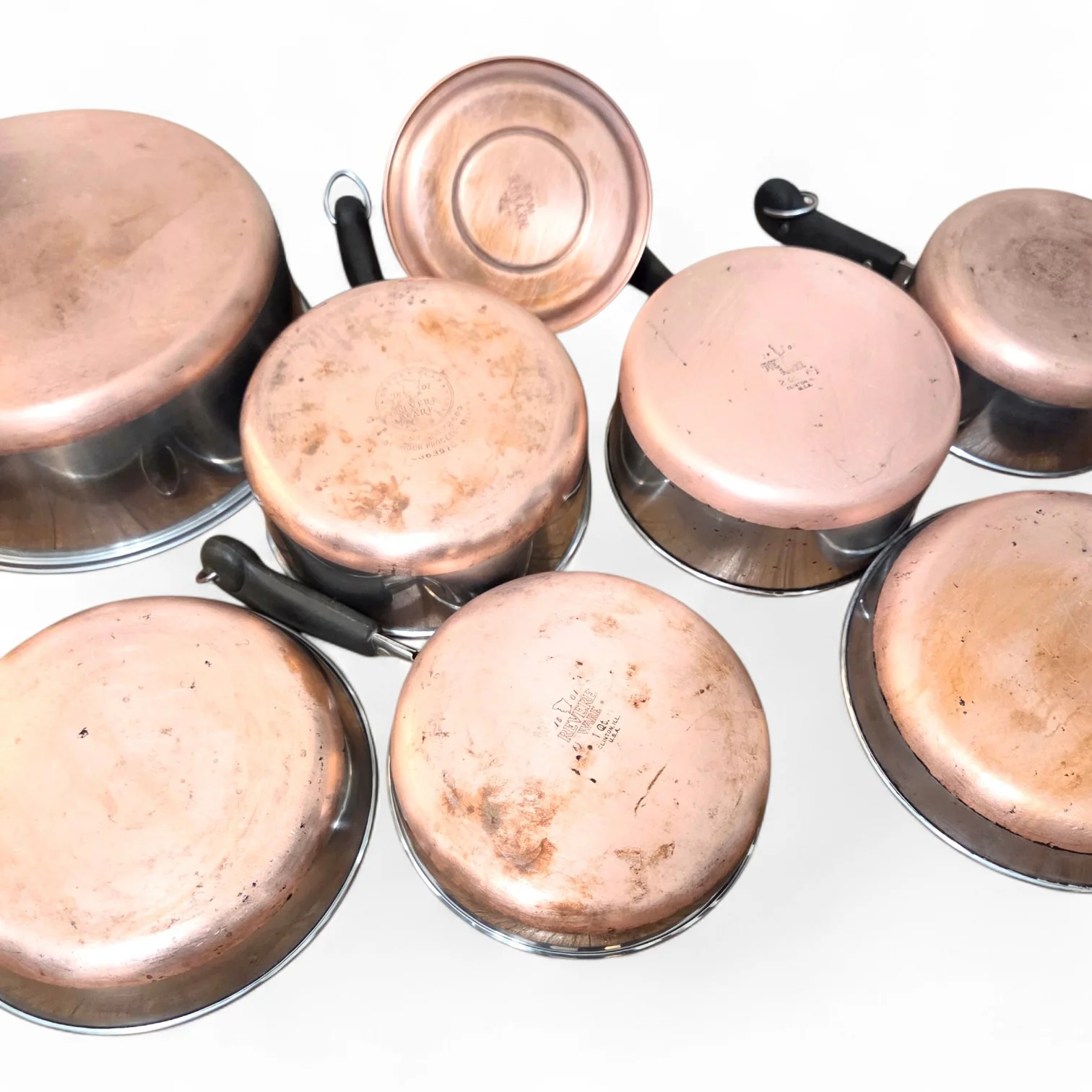
Where Cookware Impact Bonding (Cladding) Are Used
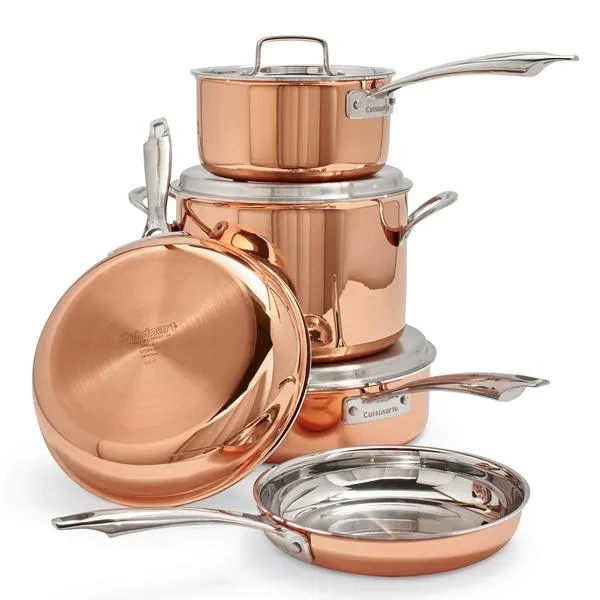
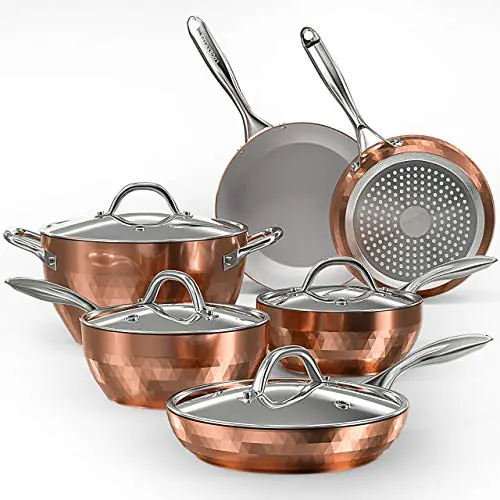
Cookware impact bonding (cladding) is widely used to manufacture high-performance cookware with superior heat distribution, durability, and induction compatibility. The bonded multi-layer construction enhances cooking efficiency while maintaining long-term product reliability and performance.
Industry Applications
Induction Cookware Manufacturing
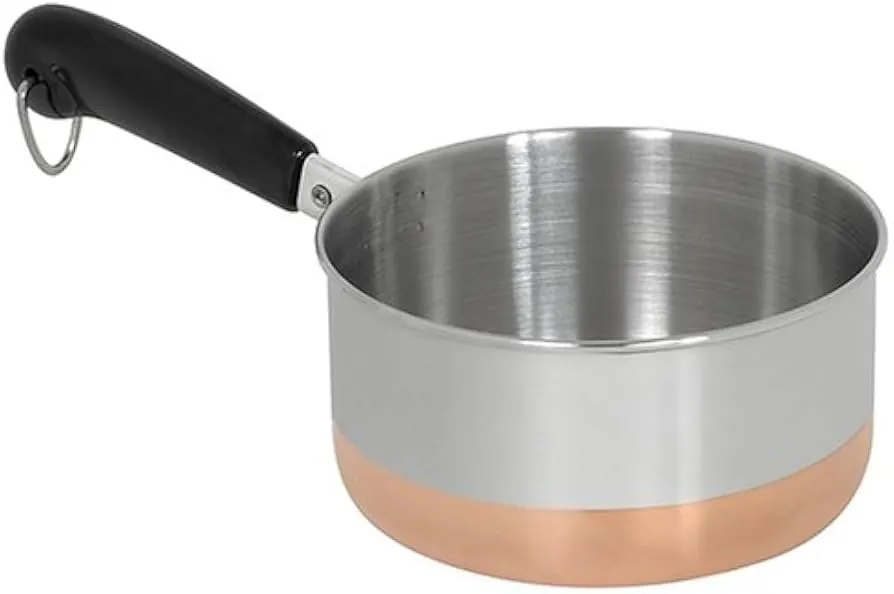
Impact bonding is used to attach induction-grade base discs to cookware bodies. This ensures efficient heat transfer and compatibility with modern induction cooktops.
Premium Stainless Steel Cookware
Multi-layer bonded bases are incorporated into high-quality pots, pans, and saucepans. The process improves thermal conductivity and cooking performance.
Commercial Kitchen Equipment
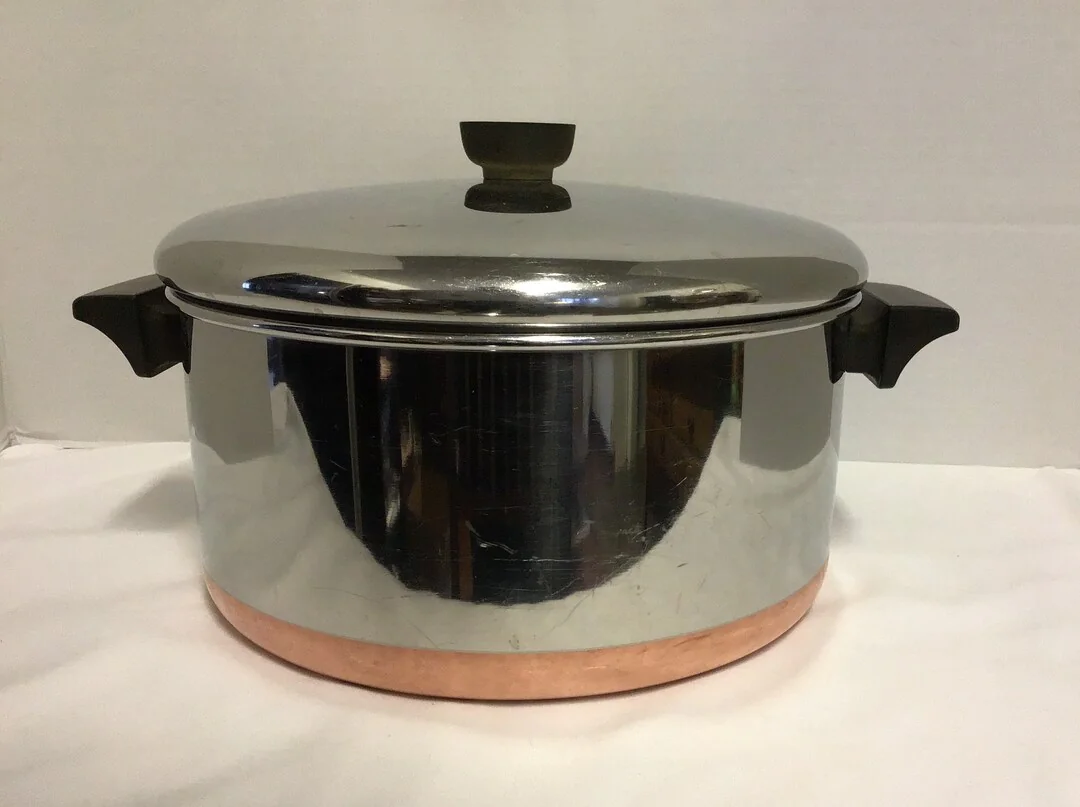
Professional cookware used in hotels, restaurants, and catering facilities utilizes impact-bonded bases for durability and uniform heating. This supports intensive daily cooking operations.
Household Cookware Products
Pressure cookers, frying pans, stock pots, and cooking vessels employ cladded bases for energy-efficient cooking. The bonded construction increases product life and enhances user satisfaction.
Finished Product Gallery
05 — Key Advantages
Why Choose the 1000-Ton Sinter Hydraulic Press
The 1000-Ton Sinter Hydraulic Press is engineered to deliver powerful, precise, and repeatable impact bonding performance for premium cookware manufacturing. Its robust construction, advanced hydraulic control, and automation compatibility ensure high productivity, superior bonding quality, and long-term operational reliability.
Proven Structural Design for Repeated Impact Loads
The heavy-duty frame is designed to withstand continuous high-pressure bonding cycles. This ensures stability, reliability, and consistent production performance over long operating periods.
High Parallelism for Uniform Base Bonding
Precision press alignment delivers even force distribution across the cookware base. This results in strong, uniform metallurgical bonds and consistent product quality.
Long Tooling and Machine Life
Optimized load distribution reduces stress on critical machine and tooling components. This extends service life while lowering maintenance and replacement costs.
Repeatable Quality for Premium Cookware
Advanced hydraulic controls maintain consistent pressure and bonding parameters in every cycle. This ensures reliable production of high-quality induction-compatible cookware.
Compatible with Automation and High-Volume Production
The press can be seamlessly integrated with automated loading, unloading, and production systems. This increases manufacturing efficiency and supports large-scale production requirements.
Global Serviceability and Standardized Components
The machine utilizes widely available industrial components for easy maintenance and servicing. This minimizes downtime and ensures dependable support throughout its operational life.